
Introduction
Luxury vinyl tile has moved from a budget alternative to the default specification in hotels, hospitals, schools, retail spaces, and high-rise apartments. The reason is simple: LVT flooring delivers a realistic wood or stone look, survives water and heavy foot traffic, and installs fast over most existing subfloors. But "LVT" covers an enormous quality range. Two products that look identical in a photo can differ threefold in wear layer, core density, and expected service life.
At Hebei Ji'ang (Xinhuacai New Material), we supply PVC and vinyl flooring to importers and project contractors in more than 40 countries. This guide covers the seven specifications that actually determine whether a given product will still look good after five years of commercial use, plus the mistakes buyers make most often.
Why LVT Flooring Dominates Modern Projects
A decade ago, specifiers chose between ceramic tile, laminate, and hardwood. Each had a fatal flaw for commercial work: tile is cold and heavy, laminate swells when it gets wet, and hardwood is expensive to maintain. LVT flooring solves all three at once. It is dimensionally stable when wet, comfortable underfoot, and repairable by replacing individual planks.
It also installs faster. A click-lock LVT floor goes down over a prepared subfloor without adhesive, which cuts labour cost and lets a room return to service the same day. For hotels and retail chains rolling out identical fit-outs across many sites, that speed compounds quickly.
Criterion 1: Wear Layer Thickness
The wear layer is the transparent PVC film on top of the printed design. It is the single best predictor of service life, and the number to check first on any quotation.
- 0.07–0.15 mm: residential only. Suitable for bedrooms and low-traffic apartments.
- 0.2–0.3 mm: light commercial. Offices, boutiques, hotel guest rooms.
- 0.5–0.7 mm: heavy commercial. Airports, schools, hospitals, shopping malls.
Buyers frequently compare LVT flooring prices without checking this figure, then discover that a cheap 0.1 mm product fails in a hotel corridor within two years. Always specify wear layer as a minimum, not a range.
Criterion 2: Core Construction - SPC, WPC, or Dryback
The core determines rigidity, temperature tolerance, and how the plank behaves over an uneven subfloor.
SPC (stone plastic composite) uses limestone powder and PVC for a dense, rigid core. It is the most stable option, handles temperature swings well, and is the standard for click-lock LVT flooring. WPC (wood plastic composite) is foamed and thicker, giving a warmer, quieter feel but less rigidity. Dryback is a thin glue-down product with no rigid core, used where a seamless finish or very tight tolerance is required.
If your project spans unheated spaces or large glazed facades, SPC is usually the correct choice.
Criterion 3: Backing and Underlayment
The backing layer controls acoustic performance and installation compatibility. An attached IXPE or EVA acoustic backing can lift impact sound insulation significantly, which matters for apartment projects with sound regulations. Where the subfloor is slightly uneven, a thicker attached backing absorbs minor deviation; where it is flat and rigid, a thin backing plus a separate underlay gives better stability.
Confirm the total thickness you are buying: two products both sold as "5 mm LVT flooring" may distribute that thickness very differently between core and backing.
Criterion 4: Waterproof Performance and Dimensional Stability
LVT flooring is inherently waterproof in the sense that the core does not swell, but "waterproof" means different things in a bathroom than in a basement. What matters is dimensional stability - how much the plank expands and contracts with temperature. A well-formulated SPC core stays within a fraction of a millimetre across a wide temperature range, so long runs do not gap or buckle.
For wet areas, pay attention to joint quality and whether the click system is rated for wet installation. And remember that waterproof planks still need a dry, level subfloor; moisture from below is a separate problem from spills on top.
Criterion 5: Finish, Texture, and UV Coating
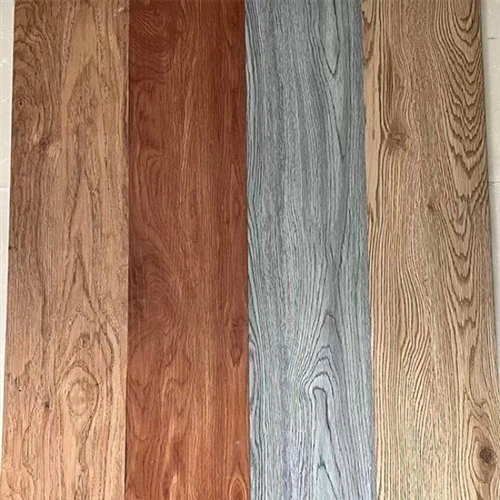
Two LVT planks can carry identical wear layers and still look completely different after a year. The UV coating protects against fading and scuffing, and the embossing depth creates the realism. Look for registered embossing, where the texture aligns with the printed grain, and a matte or low-gloss finish if the floor will be photographed or inspected under direct light.
UV-cured coatings also determine how easily the floor is maintained. A good coating means routine damp mopping is enough, with no polish or wax programme.
Criterion 6: Click System vs Glue-Down
Click-lock LVT flooring is faster to install and easier to repair, and it is the default for renovation work because it can float over existing hard floors. Glue-down installation produces a more solid feel, handles heavy rolling loads better, and is often required in healthcare and transport projects.
The choice should follow the service condition, not the installer's preference. High point loads and trolley traffic favour glue-down; fast roll-out across many identical rooms favours click.
Criterion 7: Certifications and Indoor Air Quality
For projects with green building requirements or strict indoor air standards, ask for the documentation rather than a verbal assurance. Relevant evidence typically includes low-VOC or phthalate-free formulations, floor emission class certificates, and fire performance ratings appropriate to the destination market.
Certification gaps cause more shipment delays than manufacturing problems. If your customer's specification references a particular emission class or fire standard, confirm it in writing before the container ships.
Subfloor Preparation and Installation
Even the best LVT flooring will telegraph every defect in the surface below it. Rigid SPC planks follow the shape of the subfloor, so a 2 mm bump becomes a visible ridge and a hollow spot becomes a clicking joint within months.
Preparation follows a simple sequence. First, measure flatness across the whole room - typically 3 mm over 2 metres is the working tolerance for click-lock installation. Second, check moisture. Concrete slabs must be dry to the supplier's stated limit, measured with a calibrated meter, because residual moisture is the leading cause of adhesive and backing failure. Third, repair cracks and level low spots with a suitable compound, then vacuum thoroughly; grit left under a floating floor grinds against the backing for years.
Acclimatise the cartons in the room for 24–48 hours before installation, and keep a 5–10 mm expansion gap at every wall. Skip that gap and a large floor has nowhere to move when the temperature rises.
Common Mistakes When Buying LVT Flooring
- Comparing price without wear layer. Price per square metre is meaningless until the wear layer is fixed.
- Assuming all SPC is equal. Core formulation and limestone ratio vary widely between suppliers.
- Ignoring temperature in transit and storage. Extremely cold containers can make rigid cores brittle until they acclimatise.
- Skipping the subfloor check. Even the best LVT flooring telegraphs every bump in a poor subfloor.
- Buying exactly the quantity needed. Always add 5–10% for cuts, damage, and future repairs.
FAQ
Q1: What wear layer do I need for a hotel corridor?
Specify at least 0.5 mm for corridors and lobbies, and 0.3 mm for guest rooms. Corridors see concentrated traffic and trolley wheels.
Q2: Is LVT flooring suitable for bathrooms and kitchens?
Yes, provided the joints are rated for wet areas and the subfloor is dry. Avoid standing water at the edges and seal perimeter expansion gaps.
Q3: How long does LVT flooring last?
Residential products with a 0.2 mm wear layer typically last 10–15 years. Heavy commercial LVT flooring with a 0.5 mm wear layer and proper maintenance can exceed 15–20 years.
Q4: Can LVT flooring be installed over existing tile?
Often yes, if the tile is sound, level, and the grout lines are filled. A rigid SPC core tolerates minor unevenness better than a thin dryback product.
Q5: What is the difference between SPC and WPC?
SPC has a dense mineral core for rigidity and stability; WPC has a foamed core for warmth and quiet. SPC dominates commercial specification, WPC suits residential comfort.
Q6: Does LVT flooring need underlayment?
With an attached acoustic backing, usually not on a flat subfloor. Over concrete or uneven surfaces, a separate underlay improves comfort and sound performance.
Q7: How should LVT flooring be maintained?
Damp mop with a neutral cleaner and use felt pads under furniture. Never use wax, polish, or abrasive pads on a UV-cured wear layer.
Conclusion
Choosing LVT flooring comes down to matching wear layer, core type, backing, and installation method to the actual service condition. Fix the wear layer first, then the core, then the finish - and insist on documentation for any certification your project requires.
Hebei Ji'ang International Trade Co., Ltd. manufactures PVC and vinyl flooring including SPC click-lock LVT, WPC, dryback, 4 m wide sheet vinyl, and homogeneous flooring, with export support to importers and contractors worldwide. Send us your project specification, traffic class, and destination market, and our team will match a product and provide samples.