
Introduction
Specifying vinyl flooring for a project usually starts with appearance and ends with an argument about format. Wide vinyl sheet and click-lock planks can carry the same wear layer, the same printed design, and the same warranty, yet they behave very differently on site - in how fast they install, how they handle a wet room, and how easily a damaged area can be repaired.
At Hebei Ji'ang (Xinhuacai New Material) we supply both formats, including 4 m wide sheet vinyl and SPC click-lock planks, so we have no interest in pretending one is always better. This guide compares them on the criteria that actually decide projects: seams, repairs, subfloor tolerance, speed, and total cost.
Two Formats, Two Sets of Trade-offs
Sheet vinyl arrives in rolls, commonly 2 m and 4 m wide, and is installed either loose-laid, fully bonded, or with a perimeter fix. Wider rolls mean fewer seams, and a 4 m roll can cover a small room with no seam at all.
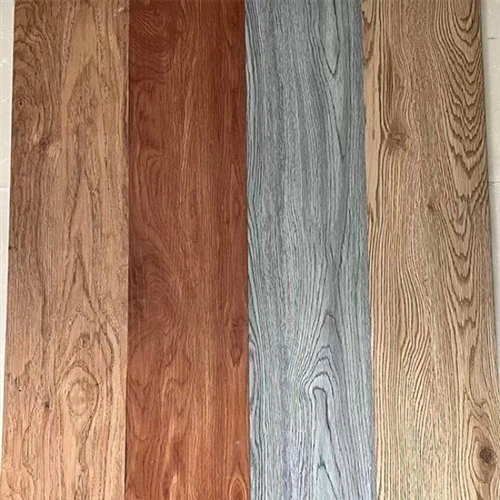
Plank and tile products are cut into individual pieces with a click system, a glue-down backing, or a loose-lay grip backing. They mimic timber and stone convincingly and allow a single damaged piece to be replaced.
The decision is rarely about which looks better. It is about which set of trade-offs matches the project.
Sheet Vinyl: Fewer Seams, Faster Cover
The defining advantage of wide sheet vinyl is the seam count. A 4 m roll installed in a corridor 3.8 m wide has no longitudinal seam, which matters enormously in healthcare, food preparation, and cleanroom environments where seams are where dirt and moisture collect.
Speed is the second advantage. A single installer can cover a large area quickly, and because there is no joint pattern to align, the work is less dependent on the skill of the fitter. For phased refurbishment - a hospital ward, a school corridor, a retail unit that must reopen overnight - that speed is often decisive.
The trade-offs are real, however. Sheet vinyl is less tolerant of an uneven subfloor, it is harder to repair invisibly, and installing it well requires careful heat welding or chemical seaming at the joints that do exist.
Plank and Tile: Repair and Handling
Click-lock vinyl flooring in plank form wins on repairability. If a section is damaged by a dropped tool or a leaking machine, the affected planks can be lifted and replaced - a compelling argument in retail, hospitality, and residential letting where damage is routine.
Planks also handle imperfect subfloors better, particularly rigid SPC cores, and they are far easier to transport and store on a constrained site. A roll of 4 m sheet needs a large vehicle and careful handling to avoid creasing.
The costs are more joints, more installation labour per square metre, and a visible pattern repeat unless the layout is planned carefully. In wet areas, joint quality becomes the critical property rather than the material itself.
Comparing the Two Formats
| Criterion | Wide sheet vinyl | Click-lock plank |
|---|---|---|
| Seams | Few, and none in small rooms | Many, at every plank edge |
| Installation speed | Fast over large areas | Slower, joint by joint |
| Repair of damage | Difficult, may need a patch | Individual planks replaceable |
| Subfloor tolerance | Low, demands a smooth base | Moderate to good with rigid core |
| Wet areas | Excellent when seams are welded | Good if joints are rated for wet use |
| Transport and storage | Bulky rolls, needs space | Flat cartons, easy handling |
| Visual design | Wide continuous pattern | Pattern repeat needs planning |
Where Each Format Wins
| Project type | Recommended format | Reason |
|---|---|---|
| Hospital ward, operating suite | Wide sheet | Minimal seams, cleanable surface |
| Food preparation area | Wide sheet | Hygiene and washdown performance |
| Retail unit with heavy footfall | Plank | Damaged areas can be replaced |
| Residential rental apartments | Plank | Repair cost and fast turnover |
| School corridor and classrooms | Either | Sheet for speed, plank for repairs |
| Office fit-out over raised floor | Plank | Accessibility and handling |
| Large open hall or showroom | Wide sheet | Continuous appearance, fewer joints |
Installation and Subfloor Differences
Subfloor preparation is where the formats diverge most in practice.
Sheet vinyl flooring needs a smooth, flat, dry base. Because the material is thin and follows the surface beneath it, a ridge or a hollow shows through immediately, and in a bonded installation any movement telegraphs to the surface. Levelling compound is usually mandatory rather than optional.
Planks with a rigid core tolerate minor unevenness, but they still need flatness within the manufacturer's stated tolerance, typically a few millimetres over two metres. Their advantage is that a small defect is less visible than it would be under sheet, not that preparation can be skipped.
Both formats need moisture testing on concrete. Neither performs if the slab is damp.
Cost Comparison: Material, Labour, and Waste
Material cost per square metre is usually lower for sheet, largely because there is no click profile to machine and packaging is simpler. Labour cost is usually lower too on large areas, since the work is quicker and seams are few.
Planks cost more in labour per square metre, and they generate more offcut waste at edges and around columns. Where the project allows, ordering 7–10% extra covers the waste; sheet typically needs less.
Against that, the repair economics favour planks over the life of a commercial space. A single damaged plank costs a few minutes of labour; repairing sheet in a busy area may require closing the space and patching a section with a visible seam.
Total cost of ownership, not price per square metre, is the honest comparison.
Format Choice and Export Logistics
Format choice also affects logistics, and for importers that consideration can outweigh a small difference in unit price. Rolls of wide vinyl flooring are bulky, awkward to store, and need a vehicle with a long load bed, which limits which distributors can handle them economically.
Cartons of plank vinyl flooring stack flat, palletise neatly, and load into a container efficiently. For a distributor serving many small projects, that handling advantage often decides the specification, even when the same wear layer in sheet and in plank vinyl flooring carries a similar price.
The practical answer for many importers is to stock both formats: sheet vinyl flooring for large, hygiene-critical projects and plank vinyl flooring for residential and repair-driven work. Offering a single format pushes customers to buy the other one elsewhere.
Maintenance and Lifecycle
Maintenance routines for vinyl flooring are similar across formats, but the consequences of neglect differ. Damp mopping with a neutral cleaner and protective pads under furniture covers most of it, and abrasive products should be avoided on any wear layer.
A sheet vinyl flooring installation with welded seams presents a continuous surface, so cleaning is straightforward and there are no joints for soil to collect in. Where a seam does fail, the repair is a specialist task rather than a routine one.
Plank vinyl flooring can be cleaned and replaced in sections, which suits spaces where a single damaged area is likely. With correct maintenance, vinyl flooring in either format delivers a long service life, and the format decision should follow the maintenance resources the end user actually has.
Common Mistakes Buyers Make
- Comparing appearance only. Design can be identical across formats while behaviour is not.
- Choosing sheet to save money, then specifying a wet area without welded seams. Seams decide performance, not the material.
- Assuming planks forgive a bad subfloor. Rigid cores tolerate minor unevenness, not bad preparation.
- Forgetting waste allowance on planks. Edges and columns consume more than expected.
- Ignoring repair strategy. A space that cannot be closed for repairs favours planks.
Specification Checklist
For either format, document:
- Area, layout, and the longest continuous run without a seam.
- Wear layer and traffic class for the intended use.
- Subfloor type, flatness, and moisture results.
- Wet-area requirements and whether seams must be welded.
- Installation method - bonded, loose-lay, or click.
- Repair strategy and spare material to be retained on site.
- Waste allowance and delivery method access.
- Acoustic and underfloor heating requirements, if any.
FAQ
Q1: Is sheet vinyl better than plank vinyl flooring?
Neither is better in general. Sheet gives fewer seams and faster installation over large areas; planks are easier to repair and more tolerant of imperfect subfloors.
Q2: Can wide sheet vinyl be installed without joints?
Up to the roll width, yes. A 4 m roll covers most single rooms and corridors with no longitudinal seam, which is a major advantage in hygiene-critical spaces.
Q3: Which format is better for wet areas?
Sheet performs best when the seams are heat welded, producing a continuous surface. Planks work in wet areas if the joint system is rated for wet installation and the perimeter is sealed.
Q4: How much more waste do planks generate?
Typically more than sheet, because every edge, column, and door reveal produces offcuts. Allow roughly 7–10% extra on planks and less on sheet.
Q5: Which is faster to install?
Sheet is faster on large, open areas because there are fewer joints. In small, complicated rooms with many penetrations, the difference narrows considerably.
Q6: Can vinyl flooring be laid over an existing floor?
Often yes, if the existing floor is sound, clean, and flat, and any loose material is removed. Always confirm moisture and adhesion requirements before overlaying.
Q7: How should vinyl flooring be maintained?
Damp mop with a neutral cleaner and use protective pads under furniture. Avoid abrasive pads and wax-based products, which build up on the wear layer.
Conclusion
Choosing between wide sheet and plank vinyl flooring is a question of project conditions, not product quality. Count the seams the space will tolerate, decide how repairs will be handled, check the subfloor honestly, and compare total cost rather than price per square metre.
Hebei Ji'ang International Trade Co., Ltd. manufactures PVC and vinyl flooring in both formats - 4 m wide sheet vinyl, homogeneous flooring, SPC click-lock LVT, WPC, and dryback - with export support for importers and contractors. Send us your project layout, traffic class, and subfloor details, and our team will recommend a format and provide samples.